Monday, July 18, 2011
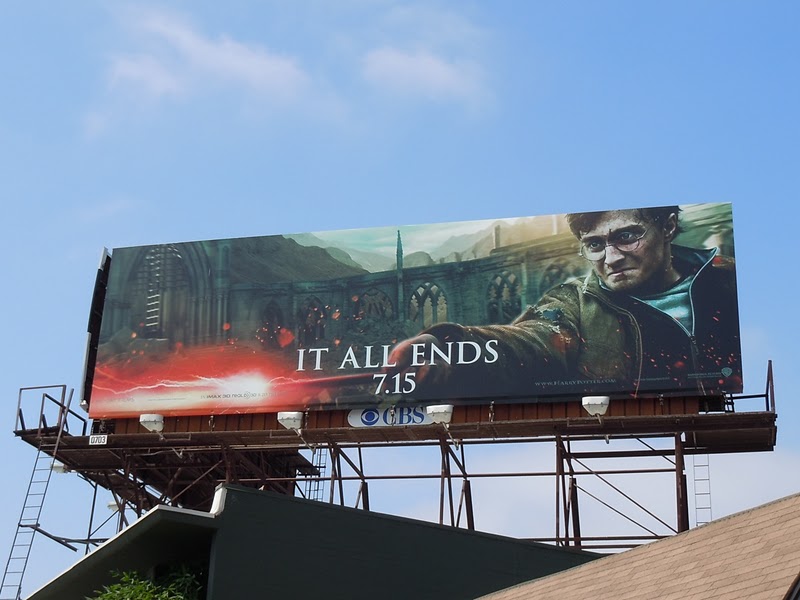
The End of the Midnight Madness: Harry Potter and the Deathly Hallows, Part 2
"Expelliarmus!"
"Alohomora!"
"Avada Kedavra!"
Hearing those pretend, faux-magicky-language spells shouted out by tween voices, watching them flick their substitute wands (anything from a twig to a drumstick to a chopstick to a sewing needle) with grandiose flourishes, checking out all the robes, cloaks, scarves, glasses, lightning bolts drawn onto foreheads... let's just say it takes me back. I was there, nine years and four months ago, when the first installment of this storied seven-book, eight-movie franchise exploded onto America's silver screens. I was standing in line (in those barbaric times before assigned seating), waiting anxiously to rush in and claim the best seats for our group of young, fresh-faced aficionados of witchcraft and wizardry. I was watching with wonder as Harry Potter's bespectacled face first filled the screen and I was listening as John Williams's majestic score first filled my ears. And I haven't missed one film since.
Looking out over the sea of eager fans, the old and the young, the costumed and non-costumed, those desperately trying to hold onto one last shred of dignity and those who had long ago abandoned all hope - you could tell it was the end of an era. Now, almost 20 hours and more than $7 billion later, we were all about to take part in the last midnight showing of the last Harry Potter film EVER. And you could tell that everyone was thinking the same thing: IT'S FINALLY ABOUT TO END!
Continue...
Friday, July 15, 2011
Book Review: George R.R. Martin - "A Dance With Dragons"
Friday, July 8, 2011
Ghosts from Charge Shot!!!’s Past: Tattoos on the Heart
Charge Shot!!! has been around for two and a half years now - amazing, we know! - and in that time we've amassed a lot of posts. Much of our writing is in an editorial vein, simply because we don't have the time or resources to report on every news item that flies across the Interwebs. Therefore, we feel that our output has a better shelf-life than you might expect from some run-of-the-mill news blog.
This feature, Ghosts From Charge Shot!!!'s Past, aims to bring some of this stuff - both good and embarrassing - to the eyeballs of our newer readers, while taking long-time constituents on a trip down memory lane. Enjoy!
Summer is upon us. For some that means vacation, afternoons in the sun, and hot hot heat. For others that means working, cranking the air conditioner, and catching as many blockbuster movies as possible.
A Better Life is not a blockbuster movie. But Entertainment Weekly did go so far as to call it “2011’s first awards movie”. This film from About A Boy director Chris Weitz charts the relationship between a struggling Mexican gardener and his Americanized son in Los Angeles. A Better Life marks Weitz’s return to “serious” film after a vacation in blockbuster land with The Golden Compass and Twilight: New Moon, and reviews indicate that it should receive some recognition in awards season if anyone can remember it six months later.
But this Ghosts post isn’t about A Better Life. It’s about the book Tattoos from the Heart, which Chris reviewed last year. The author, Rev. Gregory Boyle, founded Homeboy Industries, a gang-member rehabilitation program in Los Angeles. Boyle, along with Homeboy Industries, helped Weitz select shooting locations and capture an authentic L.A. gang atmosphere.
Tattoos, like the program it chronicles, is meant to be inspirational. Chris had this to say about that:
“You can probably guess by now what sort of book this is. You wouldn't be wrong. Each chapter is organized by some sort of inspirational theme, as Boyle stitches together anecdotes and stories of the people he's encountered and helped (or tried to help). Many of the stories end in tears and hugs; others end in tears and funerals. Boyle peppers these anecdotes with Bible quotes and references to Scripture.
But even though Tattoos on the Heart clearly has a religious agenda, I found for the most part that the stories speak for themselves.”
I never thought we’d ever review a book like Tattoos on the Heart, but I’m glad we did. It’s a window into a specific, challenging life that few would enter if they had the choice – not that different from Chris Weitz’s A Better Life.
Continue...Thursday, July 7, 2011
Yellowed Pages: The Wilk Are Among Us by Isidore Haiblum
Origin Story
This month I'll be talking about another oddity I found at a dusty old used book store. Crammed into the "fantasy" section The Wilk Are Among Us beckoned to me. And judging by the cover this could, potentially, be a fantasy novel. Is that guy with the tentacles some mystical creature? Some wizard shifting shape? I had hoped so, but it was hard, strange sci-fi all the way.
The most interesting aspect about my review of this book is that it's, in a way, an exclusive. Well, as much as you can call a review of a book from 1971 an exclusive. But I've searched far and wide and I see no reviews of this book. No one's talked about it. No one's reviewed it. I've only found one synopsis and Amazon only has two copies for sale (without even any user reviews). In a world where even a book like The Flying Sorcerers has a wikipedia page, this is a rarity. So join me as I talk for the first time online about this weird little book about aliens, tentacles and Earthlings.
Continue...
Sunday, July 3, 2011
Shakespeare a Pot Smoker? [Insert Witty Weed Shakespeare Pun Here]
“To toke or not to toke?” “Doobie or not doobie?” “Is this a reefer which I see before me?”
Let’s cut to the chase: William Shakespeare may have smoked pot.
Ten years ago, South African palentologist Francis Thackeray analyzed some pipe fragments found in Shakespeare’s garden and found trace amounts of cocaine and cannabis. Though the pipe pieces are nothing but circumstantial evidence(they were in his garden and that’s all we know), the chemical findings basically hold up. Cannabis was cultivated in Britain during Shakespeare’s lifetime, and coca leaves had been imported to Europe by the Spanish from the West Indes.
Thackeray then decided to find literary evidence that Shakespeare enjoyed recreational drugs, citing the phrases “noted weed” and “compounds strange” from Sonnet 76. This is an incredible reach. Weed didn’t become slang for marijuana until the early twentieth century; it’s likely that Shakespeare was using “weed” to mean “garments” or “style” (more here). The “compounds” are verbal, not herbal, ones. A sonnet that starts “Why is my verse so barren of new pride” isn’t about drugs. It’s about finding new words to express love.
With his physical evidence circumstantial and his literary evidence circumspect, Thackeray’s turned to the body of the Bard himself for answers. He recently applied for permission from the Church of England to examine Shakespeare’s body. Thackeray told Fox News that he plans to use “laser-surface scanning” to determine gender, cause of death, and whether or not marijuana played a role in Shakespeare’s writing process.
It’s a long shot, though. The Church of England has spent centuries honoring the inscription on Shakespeare’s grave in Stratford-upon-Avon:
"Good frend for Jesus sake forebeare,/ To digg the dust encloased heare;/ Bleste be the man that spares thes stones,/ And curst be he that moves my bones."
To get his answers, Thackeray needs the Church to follow Shakespeare’s lead: just light a pipe and relaaaax, man.
Continue...Wednesday, June 22, 2011
The Joy of the Summer Read
Friday, June 17, 2011
Book Review: Paul Theroux - "The Tao of Travel"
Sunday, June 5, 2011
Sunday Reading: Liking Is for Cowards. Go for What Hurts.
Jonathan Franzen wrote a very big book called Freedom. Many people read his very big book called Freedom (including our own Chris Holden). Generally, when many people have read the very big book you’ve written, you get invitations to speak at college graduations, the admissions/alumni/whoever-decides committee thinking that your bestselling way with words will inspiring their graduating class and perhaps – who knows? – score some points with the alumni donors.
Franzen recently spoke at my alma mater, Kenyon College. Kenyon is, in fact, the alma mater of the bulk of this website’s writing staff. Kenyon’s a small school in the middle of Ohio (aka Nowhere), so we all feel little bursts of pride when national media pays attention to it. I, for one, love sharing David Foster Wallace’s This Is Water with people. Not only do I think it’s a moving statement about the importance of sympathy in our modern age, I like telling people he spoke those words at my college.
Many of us Kenyon alums are similarly growing over Franzen’s speech, recently adapted by the author into a New York Times op-ed, “Liking Is for Cowards. Go for What Hurts.” Franzen couldn’t have picked a better college at which to use moderate Ludditism to remark upon our culture’s guarded emotional state: only a few years ago did Kenyon students stop scowling at cell phone users walking their beloved Middle Path.
Some people may not agree with this editorial, but it’s worth reading to arrive at that conclusion. Consumer technology is so pervasive, its cultural impact so broad yet little understood, it bears philosophical exploration. Consider this quote from Franzen:
“To speak more generally, the ultimate goal of technology, the telos of techne, is to replace a natural world that’s indifferent to our wishes — a world of hurricanes and hardships and breakable hearts, a world of resistance — with a world so responsive to our wishes as to be, effectively, a mere extension of the self.”
Franzen moves on to decry irony and encourage us toward real love, real appreciation of the world around us. Brush it off as environmentalist mumbo jumbo and you may be missing his point: we are paying a cultural cost by blindly embracing technology.
Read the piece. See if you agree. Need I remind you? He spoke at my college.
Continue...Friday, June 3, 2011
A Classic Case of Sequelitis
“Sequelitis - A medical condition propagated by a combination of commercial success and creative ineptitude. Symptoms include bad movies and music, arrogance, denial, and desperation. In that order.” – Urban Dictionary
Ahh…sequels. We love them (sort of). We hate them (sort of). We love to hate them (when we don’t have anything better to do).
Some sequels mean well. They’re rightly born of the original intellectual property, crafted by the original creator, and closely linked to their source. Fans accept them into canon. They create wikis to explain the connections between installments. Good times are had by all.
Some sequels are evil. They’re cash grabs, products of creative bankruptcy and fiscal trepidation. They cause fans to hate they things they once adored or, at the very least, enter into blissful ignorance of a given franchise. Good times are had by no one.
I’m sure you can think of examples of both. Star Wars has entries in each category – Final Fantasy, too. If I knew more about the Harry Potter series, I’d mention those as well.
With The Hangover II boring many critics and sequels starring pirates and giant robots dominating the summer lineup, it’s easy to think that all sequels are disingenuous hackjobs. But some do deliver on the promise of their forbearers – for every three movies starring Big Momma, there’s one The Dark Knight.
Sequelitis the disease is not confined to movies and videogames. And it’s worse when the original authors aren’t even involved. Plenty of books, television shows, and other properties fall prey to it – even plays! Especially the classics.
Continue...Thursday, June 2, 2011
Yellowed Pages: The Flying Sorcerers by David Gerrold & Larry Niven
Friday, May 27, 2011
Book Review - Carsten Jensen, "We, The Drowned"
Friday, May 20, 2011
A Novel Theory: Why Isn't Fiction Culturally Relevant?
Thursday, May 5, 2011
Yellowed Pages: The Atlantic Abomination by John Brunner
Origin Story
I found The Atlantic Abomination at one of my favorite used book stores in Philadelphia. Germ Books, now closed for business (travesty), stocked its shelves full of weird, smelly, crappy science fiction. There's something really special about going in to a specialty book shop and picking up a book based solely on its cover.
Now, look at this cover, I doubt any one of us could have passed on this gem. What we see is the Abomination himself, looking a bit like a fat blue crab/bird while terrified humans look off to the distance. This, in essence, is the whole story of The Atlantic Abomination, published in 1960. Join me as we talk cold war, aliens, mind control, and bad editing!
Continue...
Friday, April 22, 2011
Book Review:
David Foster Wallace - "The Pale King"
Casting for Political Correctness – Game of Thrones and Fantasy Racism
The first episode of HBO’s Game of Thrones aired just this past Sunday and already there’s controversy brewing: racism.
Our own Jordan Pedersen said nothing about this in his review, but it appears that more than a few TV critics are a little unnerved by the Dothraki, GoT’s barbarian horde. Adam Serwer, writing for the Atlantic, expressed disappointment at the casting department’s choice of “miscellaneous brown people.” TIME’s James Poniewozik wondered if “if it's possible to be racist toward a race that does not actually exist” while calling the Dothraki a “grabbag of exotic/dark/savage signifiers.”
Caveat: I have not read any George R.R. Martin, and I have yet to see Game of Thrones. But this issue is larger than one HBO series (no matter how huge the hype). Racism and other forms of prejudice crop up in fiction because it remains an unfortunate part of society, however veiled it may be.
And while the public seems generally okay with capital-l Literature, etc. exploring such topics (with a few capital-n Notable exceptions), we get nervous when they appear in our pulpier entertainments like fantasy or science-fiction.
Continue...Friday, April 8, 2011
Artists and Critics - How Much Contact Do We Want?
Thursday, April 7, 2011
Yellowed Pages: God of Tarot by Piers Anthony
Zoinks! OED update includes OMG and LOL
Time to get annoyed when your spellcheck scribbles red underneath your 21st-century vocabulary. The Oxford English Dictionary now includes several words popular with millennials, surely to the ire of English professors everywhere.
The latest update legitimizes initialisms (abbreviations consisting of sequential first letters from a name or expression) borne out of online interaction. That’s right, OMG and LOL are now totally viable words according to the OED. But it’s not just their useful on Twitter that earned them passage into everyone’s favorite English lexicon.
Such abbreviations are cropping up in print and everyday speech, and convenience isn’t the reason, say the OED folks:
“The intention is usually to signal an informal, gossipy mode of expression, and perhaps parody the level of unreflective enthusiasm or overstatement that can sometimes appear in online discourse, while at the same time marking oneself as an ‘insider’ au fait with the forms of expression associated with the latest technology.”
For a generation that grew up in AOL chat rooms and now groans every time their parents text them “LOL u r so funny,” this is exactly the usage of Internet initialisms. Writing for Thought Catalog last November, Leigh Alexander called for an end to online use of LOL, citing ironic use and the fact that it’s rarely ever true. Think about it. I’m more likely to type “hahaha” to friends online than LOL, unless I’m being cute or snarky.
There’s a hope (or perhaps fear) that the inclusion of OMG and LOL will open the OED floodgates for more Internet speak. Ben Hardwidge over at Bit-Tech asked OED principal editor Graeme Diamond if we’d ever see l337 in the dictionary. “It’s got a good chance, but it may not quite cross the line yet,” says Diamond. The inclusion of numbers won’t prevent it (check out 1471), but its niche usage might.
What other Internet words should we see in the OED? ROFL? idk? Butthurt?
Friday, March 25, 2011
Opting Out of Opting Out:
The Latest Round in the Google Books Saga
Tuesday, March 8, 2011
Books to Movies: The Chronic... cles of Narnia
The next step in the movie franchise is unclear. Will the fourth film in the series be The Silver Chair (the fourth book published) or The Magician's Nephew (the last book published, but the first in the chronology of Narnian myths)? SPOILER ALERT: All the familiar actors have been phased out of the story, so there's no concern with aging, as there was with Harry Potter. No one on imdb or Wikipedia has the answer, so I'm assuming the question doesn't yet exist.
My question is: How can any film studio worth its salt let this opportunity for a potential seven film series, with the stories already written and a fanbase already determined, pass them by? It would be embarrassing for everyone involved if they had to cut the project short 3/7ths of the way to the finish line. And in this age where everything's a franchise and new ideas for films are all but extinct, how can they not get to seven movies? But just how viable is a (SPOILER ALERT AGAIN) Jesus allegory in a time where the most talked-about movies (Social Network, King's Speech, The Fighter, 127 Hours) are based on recent, true stories rather than myths? That's part of what I aim to find out with this project.
Continue...


